
City of Bristol Criminal Court Records
A criminal court record is the court case file opened when charges are filed in Superior Court. For Bristol, the local criminal and motor vehicle venue is Superior Court GA17 at Bristol. More serious New Britain Judicial District Part A matters may be handled through New Britain. The court record is maintained by the Judicial Branch and the Clerk of the Superior Court, not by a county sheriff or a local city court.
The case file can include the charging document, arraignment entries, bond or release conditions where public, motions, continuances, plea entries, hearing dates, trial or plea results, disposition, sentence, probation terms, and financial obligations. Arrest reports may start with Bristol Police, but once charges are filed the criminal court case becomes a separate court record. For the closer arrest-to-charge path, use the City of Bristol arrest records and court charges resource; for all case types, use City of Bristol court records.
Search Bristol Criminal Court Records
The main online access channel is the Connecticut Judicial Branch criminal and motor vehicle docket search area. It links to pending cases, daily dockets, convictions, docket-number searches, and attorney or firm lists. The conviction search by defendant can be used for disposed criminal and motor vehicle convictions. Pending case and daily docket searches are better when the matter is active or the next appearance is the key fact.
- Open the Judicial Branch criminal and motor vehicle docket search area.
- Choose pending case, daily docket, conviction, or docket-number lookup based on the case status.
- Search by defendant name, docket number, court location, category, or date where the selected form allows.
- Use Bristol GA17 for local Bristol criminal and motor vehicle matters when a location filter is available.
- Contact the Clerk of the Superior Court for certified copies or documents that are not viewable online.
The Criminal/Motor Vehicle Convictions Search by Defendant supports conviction lookup by defendant name.
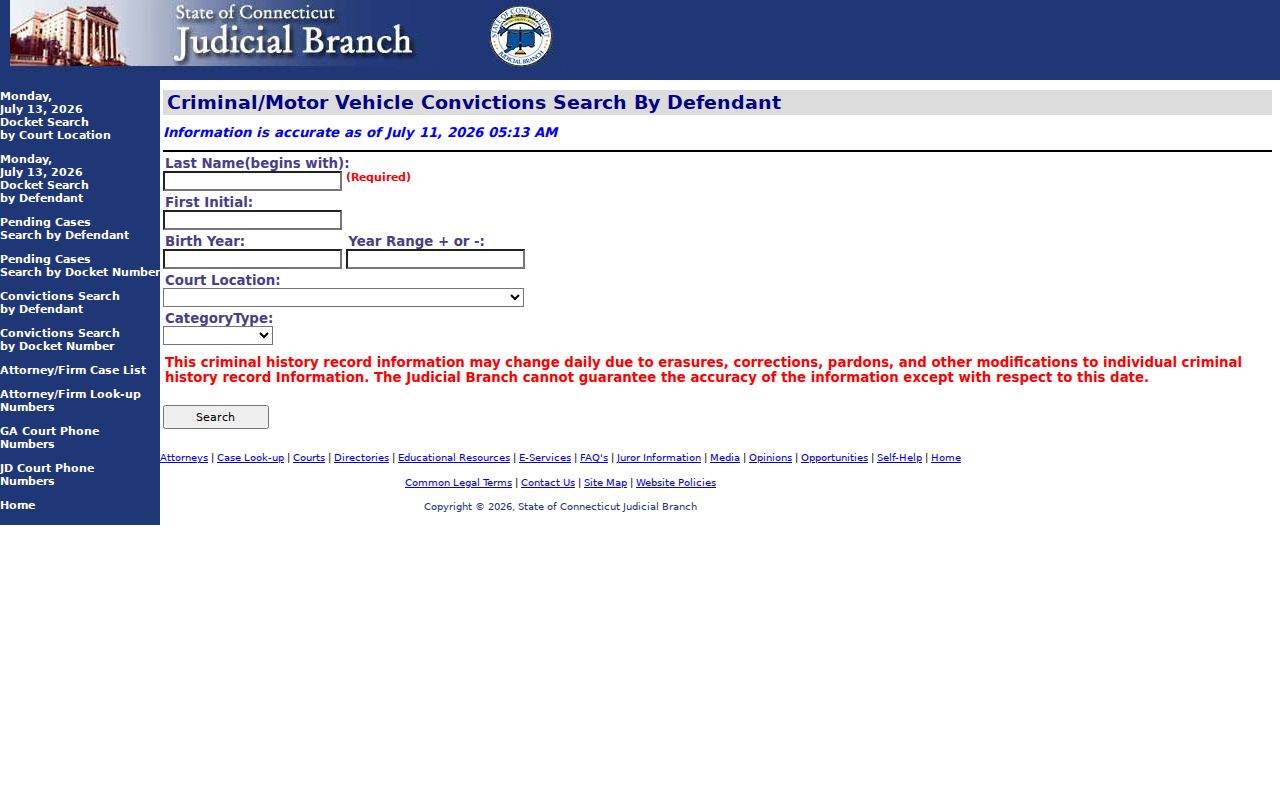
That conviction search is useful for final outcomes, but active charges and same-day court events require the pending case or daily docket tools.
Bristol Criminal Case Stages
Criminal court records should be read as a timeline. The filing of charges begins the court case record. Arraignment brings the accused before the court for early case action and release conditions. Pretrial events can include motions, continuances, discovery activity, negotiations, and hearings. A case can end through dismissal, nolle, plea, trial verdict, or another disposition. Sentencing follows a conviction or qualifying plea.
Case flow: Charges Filed › Arraignment › Pretrial / Motions › Plea or Trial › Disposition › Sentencing
| Stage | What Happens |
|---|---|
| Charges filed | The prosecutor files or proceeds on the formal accusation, often after a police arrest or warrant return. |
| Arraignment | The court addresses the charges, release conditions, counsel, and next appearance. |
| Pretrial / motions | The docket may show hearings, continuances, motions, negotiations, and orders. |
| Plea or trial | The defendant may plead, go to trial, or have charges resolved another way. |
| Disposition / sentence | The record shows the outcome and any sentence, probation, or financial obligation where public. |
What Bristol Criminal Records Show
The public record may not show every document, but it can show enough to understand the court case path. Bristol criminal court records may identify the defendant, court location, category, charges, statute references, offense descriptions, arresting agency, docket events, court dates, disposition, and sentence entries. Bond or release conditions may appear in the court file, but they are not always visible in public portal results.
| Field | What It Shows |
|---|---|
| Docket number | The unique criminal or motor vehicle court case number. |
| Defendant | Name and identifying fields that are public in the selected search result. |
| Court location | The venue handling the case, including Bristol GA17 when applicable. |
| Charges | Offense descriptions, statute references, and charge status where visible. |
| Events | Arraignments, hearings, motions, continuances, pleas, orders, and dates. |
| Disposition | The outcome of a charge or case, such as guilty, dismissed, not guilty, or nolle. |
| Sentence | Probation, confinement, fines, or other court-ordered results after conviction where public. |
Charges vs Convictions
A charge is an accusation. A conviction is a final outcome based on a guilty plea, finding, or verdict. City of Bristol criminal court records can show both, and a single case can include charges that were amended, reduced, dismissed, nolled, or resolved differently from other counts. Do not treat the presence of a charge as proof of guilt.
| Point | Charge | Conviction |
|---|---|---|
| Stage | Filed accusation in the court case. | Final guilty result by plea, finding, or verdict. |
| Proof level | Based on probable cause or charging authority. | Requires a criminal conviction standard. |
| Record effect | May remain pending, change, drop, or be dismissed. | Can lead to sentencing, probation, fines, or custody. |
| Lookup use | Read current allegations and case movement. | Read final outcome and sentence history. |
The Connecticut criminal records statutes address erasure and other criminal record rules that can change what remains publicly available.
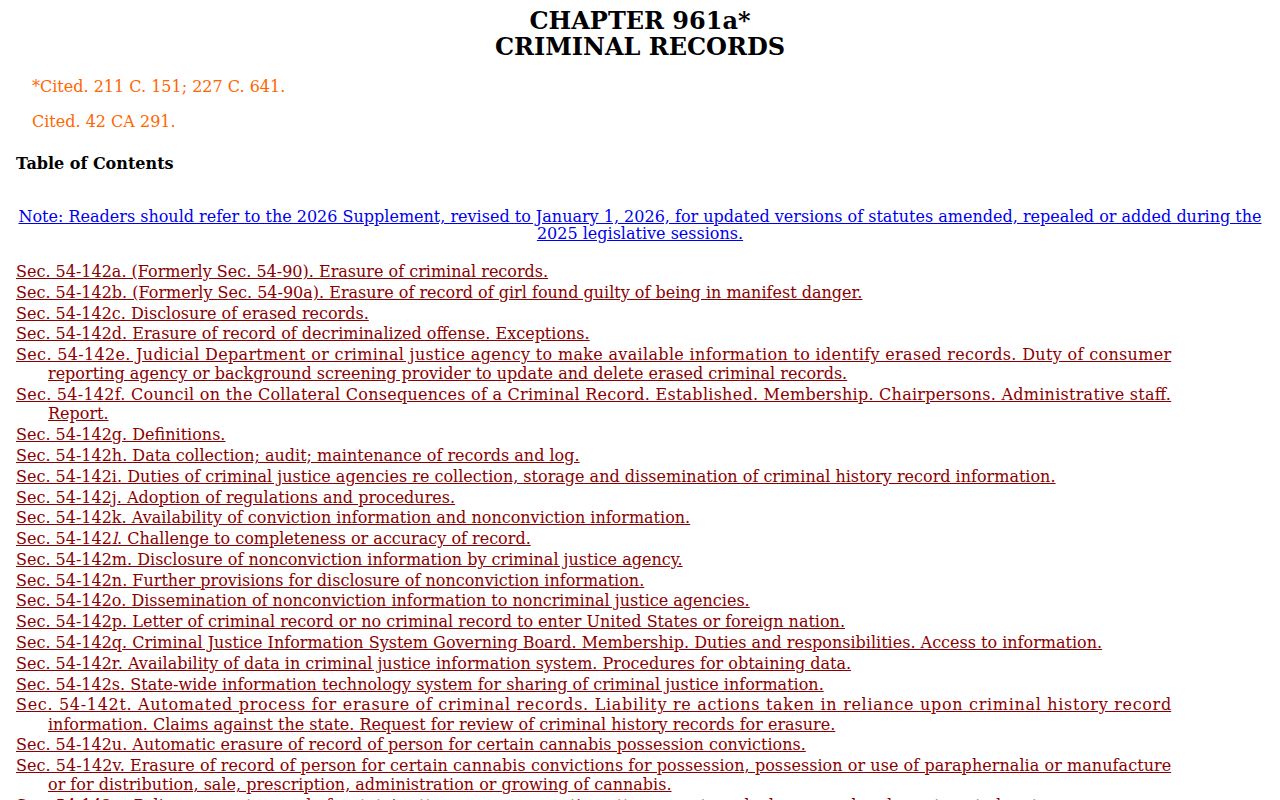
Those rules help explain why older dismissed, pardoned, decriminalized, or qualifying nolled matters may disappear from ordinary public search results.
Reading Dispositions and Sentences
A disposition is the outcome of a charge or case. In a Bristol criminal court record, common outcomes may include guilty, not guilty, dismissed, nolle, or another court-specific entry. A nolle means the prosecutor has decided not to proceed at that time; Connecticut erasure rules may later affect nolled charges after statutory timing is met. A dismissal or not guilty result is not the same as a conviction.
Sentencing entries should be read with the charge they belong to. One count may have probation, another count may be dismissed, and another may carry a fine or other order. Probation, financial obligations, and court conditions are case-specific. If a sentence entry is unclear, the clerk's file or counsel may be needed to confirm the exact order.
Sealed vs Erased Records
Connecticut uses the term erasure for several criminal record outcomes. Erasure can apply after not guilty findings, dismissals, certain nolles after elapsed time, absolute pardons, and decriminalized conduct. A sealed record is different. It remains a court file, but public access is restricted by order or law. A person seeking a sealed record usually needs to be a party, attorney, or someone with a court order.
| Point | Sealed | Erased |
|---|---|---|
| Public visibility | Hidden from ordinary public access. | Treated as unavailable for ordinary public disclosure. |
| Record status | Still exists under restricted access rules. | Covered by Connecticut erasure law for qualifying outcomes. |
| Common route | Court order, statute, or restricted case type. | Dismissal, not guilty, qualifying nolle, pardon, or decriminalization. |
| Practical step | Ask the clerk or counsel about access rights. | Verify disposition and timing with the court or counsel. |
Access to Bristol Criminal Records
Criminal court access is shaped by both open-record principles and criminal-record restrictions. Connecticut public-record law includes Chapter 14, while criminal records statutes address erasure. Juvenile matter confidentiality is handled under Connecticut juvenile matter statutes. Together, those sources explain why a public criminal docket can exist for one case while another record is withheld or later erased.
State prosecutorial context also matters. Bristol is in the New Britain Judicial District. The Part A office handles more serious cases, mostly class A or B felonies from the district, while geographical-area Part B prosecution covers many class C, D, and E felonies, misdemeanors, infractions, and motor vehicle offenses. The New Britain State's Attorney page is the official prosecution source for that district.
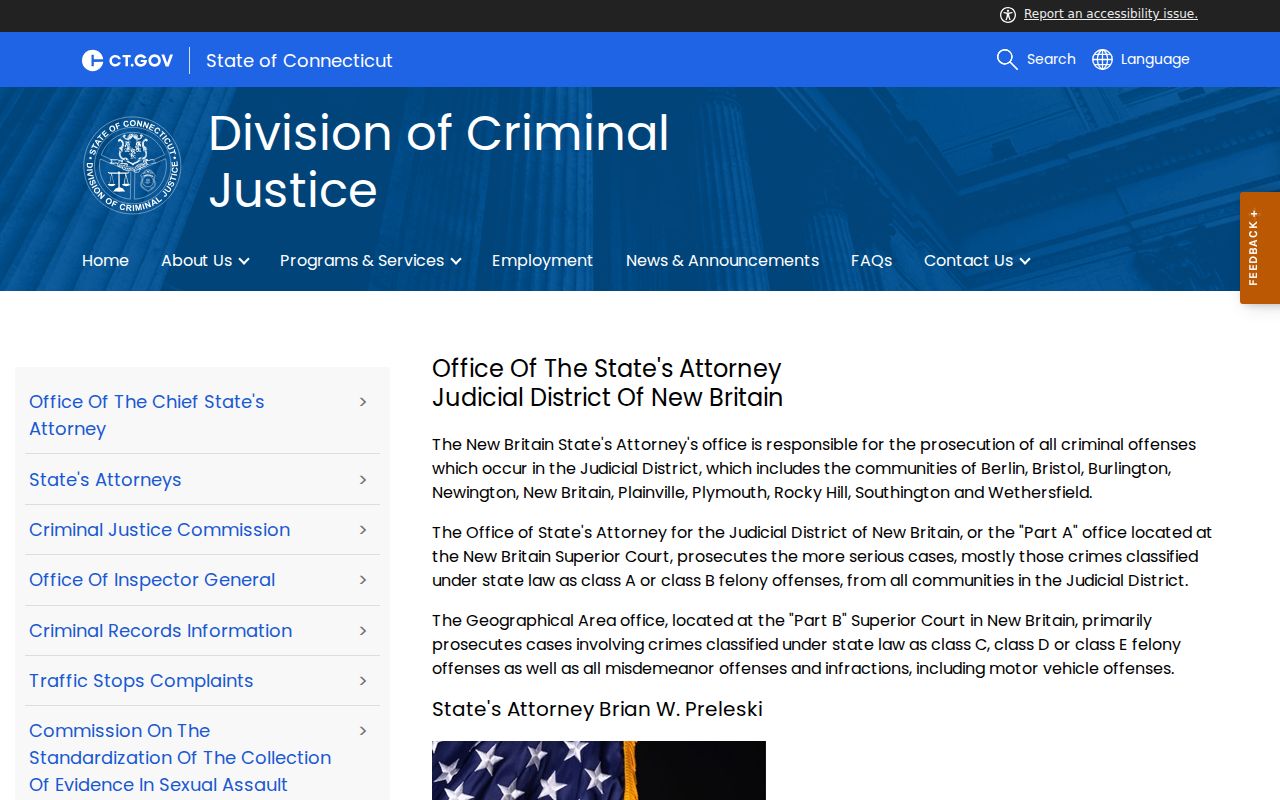
The prosecutor's office is not a general records counter, but its role helps explain how charges from Bristol move into the Superior Court criminal case file.
Restricted Bristol Criminal Court Records
Juvenile matters, erased records, sealed cases, protected personal identifiers, some victim information, medical details, sexual assault material, and ongoing investigative records can be withheld or redacted. Bristol Police also states that arrest reports are not released by the department until all charges have been adjudicated in court. That police rule does not mean the court docket is closed, but it can limit access to the police report behind the case.
For certified copies, use the Clerk of the Superior Court. For state criminal-history checks, use the Connecticut Department of Emergency Services and Public Protection criminal-history process rather than the court docket alone. For jail status, use the Connecticut Department of Correction lookup rather than a criminal court docket. Each record holder answers a different question, and mixing them can lead to an incomplete result.